- AI Is Creating More Code. Is Your Mac Infrastructure Ready for What Comes Next?
AI Is Creating More Code. Is Your Mac Infrastructure Ready for What Comes Next?
Writing code got faster. Building and testing it did not.
Ask an engineering leader what AI changed in the last two years and you will hear about speed. Code gets drafted faster. Refactors happen in minutes. Tests get scaffolded automatically.
Code does not ship as soon as it’s written. It must be built, tested, signed, and released. For teams building for iPhone, iPad, Mac, or Vision Pro, that downstream work depends on Apple hardware.
And as developers produce more code, the infrastructure behind them has to absorb more work.
MacStadium surveyed 300 DevOps, platform, infrastructure, and SRE professionals to understand what that pressure looks like in practice. The results point to a broader shift: AI is not eliminating engineering constraints. It is moving them.
AI removed one constraint and exposed another
AI coding tools have changed how quickly developers can produce changes.
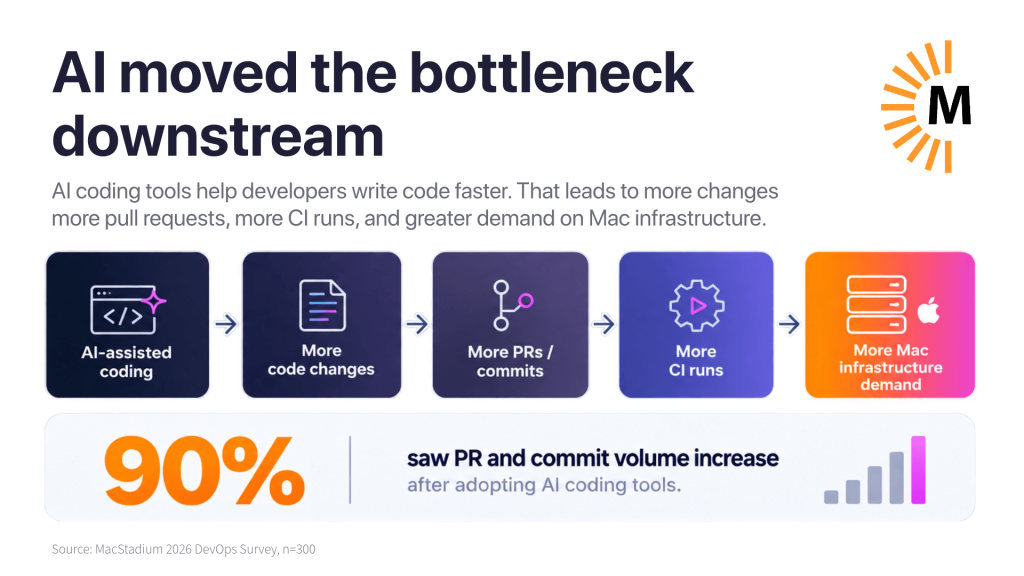
The survey suggests the downstream effect is already substantial: 90% of respondents said pull request and commit volume increased after their teams adopted AI coding tools. (Only 10% reported no change.)
That makes sense. Faster code generation means more changes to the codebase. More changes mean more pull requests. More pull requests mean more builds and tests.
AI breaks the old capacity-planning math
Historically, infrastructure demand tended to grow alongside developer headcount.
More developers meant more commits, more builds, and eventually more hardware needed to support them. Capacity planning was never perfect, but the relationship was relatively easy to see coming. Teams hired, budgeted, and added infrastructure accordingly.
AI broke that planning model.
The same number of developers can now generate more changes, which means substantially more work for CI systems without a corresponding increase in headcount.
That pressure is already showing up in budgets. Eighty-three percent of respondents said AI adoption has increased their Mac infrastructure costs. More than a quarter described the increase as significant.
The important shift is not simply that teams need more compute. It is that infrastructure demand can now grow much faster than the traditional signals organizations have used to plan for it.
Build queues are not where teams are struggling
If AI is generating more CI activity, you might expect teams to be drowning in build queues.
According to the data. They are not.
Only 6% of respondents said long queues frequently affect development. Meanwhile, 21% said they have excess capacity sitting unused.
Instead, respondents spread their challenges across the operational side of running Mac CI, with no single issue named by more than about a quarter of them:
- Hardware procurement and lead times: 26%
- CI/CD tool integration: 25%
- Security and compliance: 23%
- Fleet management: 22%
- Scaling capacity: 22%
- Skills gaps: 22%
- Environment fragmentation: 18%
(Respondents could select multiple challenges, so above totals exceed 100%.)
That spread suggests the pressure is operational as much as it is about raw machine count.
The average team in the survey operates 81 physical Macs for CI/CD. At that scale, infrastructure comes with operational overhead.
Procurement takes time, machines need lifecycle management, and every new Xcode and macOS release adds another environment to keep in sync.

Developer time is where infrastructure friction gets expensive
Those operational problems eventually surface somewhere. Often, they surface in release timelines and developer experience.
Sixty-seven percent of respondents said developers lose at least an hour every week to Mac CI issues. Nearly a quarter lose six hours or more — most of a working day each week.
That time disappears into activities such as waiting for an environment, troubleshooting a failed runner, chasing configuration drift, rerunning builds that failed unexpectedly, or managing infrastructure instead of building software.
So the visible cost is the hardware, but the more consequential cost is the engineering time spent waiting on it, troubleshooting it, or working around it.
The question is no longer just "How many Macs?"
For years, the obvious infrastructure-planning question was: How many Macs do we need? That question still matters, but it’s no longer enough.
A better question is: How quickly can your Mac infrastructure respond when demand changes?
That requires thinking about more than raw capacity:
- Provisioning: Can a clean environment come online quickly when a job needs one?
- Consistency: Do two developers running the same job get the same environment?
- Utilization: Is hardware doing useful work, or sitting idle between demand spikes?
- Remote management: Can the fleet be operated without someone physically touching each machine?
- Automation: Can capacity respond to CI demand without waiting for a person to intervene?
- Observability: Can teams see where developer time and machine capacity are actually going?
Taken together, those are broader infrastructure questions than simply deciding how many machines to buy. Teams answer them in different ways: in-house tooling on owned hardware, virtualization, or hosted Macs.
And they matter more as AI increases the pace of development.
The bottleneck didn't disappear. It moved.
Most conversations about AI in engineering focus on developer productivity, and the survey suggests the resulting pressure is beginning to show up in the systems that build and test all of that newly generated code.
The implication is not that AI coding tools are creating a problem. It is that infrastructure strategies designed around the old pace of software development may not fit the new one.
The full MacStadium 2026 DevOps Survey, with the complete breakdown of responses, is available here.